


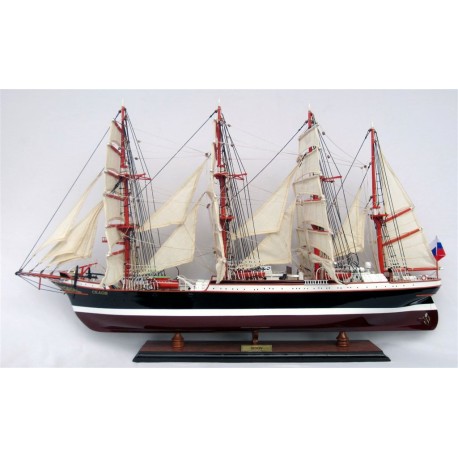

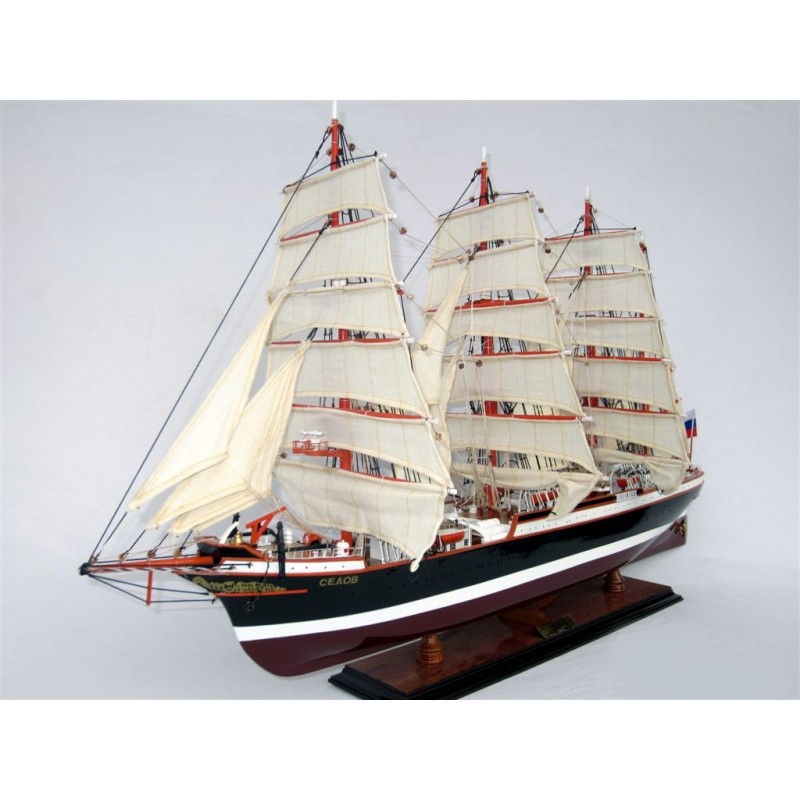


STS Sedov (Russian training ship)
TS0089P-80
New product
90cm model of the Russian Sail Training vessel Sedov (Седов), previously named Magdalene Vinnen II
- Write a review
More info
Magdalene Vinnen II
The Sedov, originally named the Magdalene Vinnen II, was launched in Kiel in 1921 by the shipping company F. A. Vinnen & Co. of Bremen, one of the largest German shipping companies at that time. The shipping company initially objected to have an engine installed in the ship, but the ship yard (with backing from a Government committee) successfully argued for an engine, making the ship the first sailing ship with auxiliary engine designed to modern principles.
The Magdalene Vinnen II was then the world’s largest auxiliary barque and used exclusively as a cargo ship with a crew that was partially made up of cadets. Her maiden voyage was on September 1, 1921. Her voyage took her from Bremen via Cardiff, where she took on coal, to Buenos Aires. Despite bad weather, the journey from England to Argentina with holds full of coal took just 30 days. The Magdalene Vinnen II carried all sorts of cargo: apart from coal, she took timber from Finland, wheat from Australia, pyrite from Italy and unit load from Belgium. The four-masted barque made two voyages around Cape Horn to Chile. Until her last voyage under the Vinnen flag in 1936, the ship sailed to Argentina, South Africa, Australia, Reunion and the Seychelles.
On August 9, 1936, the Magdalene Vinnen II was sold and renamed the Kommodore Johnsen. The new owner modified her to a cargo-carrying training ship. More accommodation was provided as the ship, apart from her permanent crew, was to have a complement of 50 to 60 trainee officers on each journey.
Sedov
She came under Russian state ownership after the surrender of Germany — on December 20, 1945, the British handed over the ship to the Soviet Union as war reparation. Renamed the Sedov after the Arctic explorer Georgy Sedov who died during an investigation in the Arctic in 1914, she was converted and used as a Naval training ship from 1952 to 1957. She made several friendly visits to South America and Africa during this period. From 1957 to 1966 she was used as an oceanographic research ship in the North Atlantic. During these voyages, the Soviet Navy also used her for training of young cadets. In 1966 she was transferred to the reserve in Kronstadt, formally under the civil ownership of the Ministry of Fisheries. In the 1970s, she was only infrequently used as a training ship, sailing in the Gulf of Finland.
In 1981, the Sedov reappeared following renovations. New features were added such as a glass-domed banquet hall with a stage and a movie theatre and she was based at the Baltic Division of Training Ships in Riga. Cadets from schools of navigation of Kaliningrad and Murmansk sailed on the Sodov. After the declaration of independence of Latvia in 1991, she left Riga for Murmansk, transferred to the Murmansk naval school with the city of Murmansk ensuring her management and maintenance.
Sedov has regularly been targeted by unpaid creditors of the Russian Federation - in 2002 Sedov was forced to precipitously and unexpectedly leave Marseilles in the dead of night to avoid being served a writ by AFPER (French association of holders of Russian Empire bonds) the following morning.
In 2011 Sedov celebrated her 90th anniversary. In 2012 Sedov started her first voyage around the world of more than 13 months. It was finished July 20, 2013 in Saint Petersburg (Russia).
Reviews
